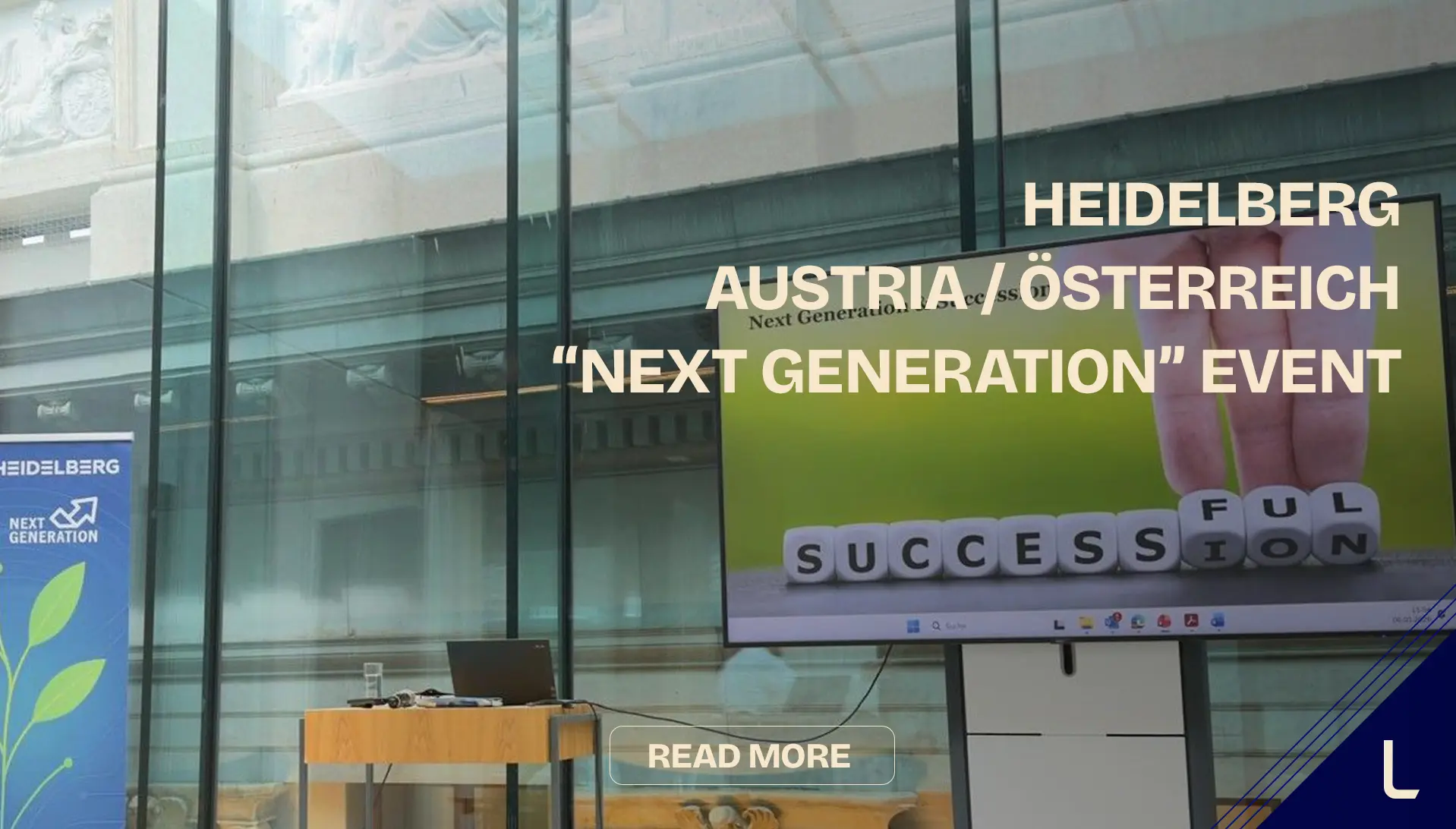
The first day of the event took place in the historic setting of the Austrian Parliament. Prof. Dr. Reinhard Prügl, president of VIF@WU | Vienna Institute for Family Business, established within WU (Vienna University of Economics and Business), shared his research on family businesses.
📖 Definition of a Family Business, Academic Approaches, and Concepts
“A family business is an enterprise controlled by a dominant coalition consisting of members of the same family or a small number of families, managed and/or directed with the intention of shaping and sustaining the business’s vision, and thus possessing the potential to be sustainable across family generations.” (Chua, Chrisman & Sharma, 1999, p. 25)
This definition of a family business emphasizes that such companies are not merely economic entities; they are also managed with a vision and a commitment to sustainability that spans generations. In other words, a family business is viewed as an organization that aims to preserve family values and long-term goals beyond mere financial performance.
Socio-Emotional Wealth (SEW): As defined by Gomez-Mejia et al. (2007), this concept describes how family businesses operate not only to generate profit but also to preserve family identity, reputation, and bonds. In other words, family members are emotionally attached to the company, so they make decisions not solely to generate profit, but also to uphold family values, build strong relationships, and pass the company on to future generations. For this reason, family businesses are naturally more inclined toward long-term thinking and sustainability.
Long-Term Management 4C: Miller & Le Breton-Miller (2005) base the competitive advantage of family businesses on four pillars: Continuity: The desire to continue across generations; Community: Building strong bonds with employees and business partners; Connection: Maintaining relationships with customers and the community, Command: The power to steer the company.
The “4C” approach highlights that family businesses focus on long-term success rather than short-term profits. They plan their investments and decisions in a way that benefits future generations, and this long-term competitive advantage explains how family businesses have managed to survive for generations.
Resource Management Sirmon & Hitt (2003): Highlights different types of capital in family businesses: Human capital, Social capital, Patient capital (long-term investment mindset), Survival capital (resilience to crises), Governance structure and costs. The proper integration and utilization of these resources ensure the long-term survival and growth of family businesses.
When considered together, these three approaches establish a strong connection between the values of the new generation and academic theories: identity and belonging, a long-term vision, and multidimensional resource management.